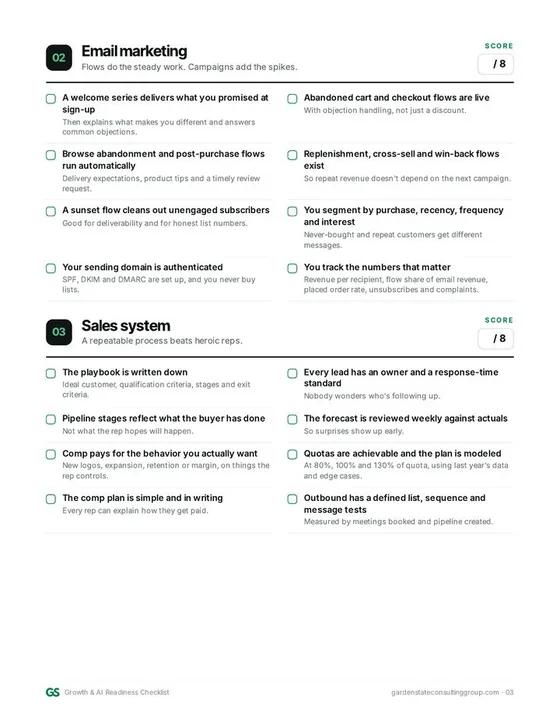
A comp plan should pay for the behavior you want. Decide that behavior first, choose the building blocks (pay mix, OTE, quotas, accelerators, SPIFs and clawbacks), follow a few simple rules, and model the plan before you roll it out.
Your compensation plan is the loudest message you send your sales team. You can say "we care about profitable growth" in every meeting, but if the plan pays the same for a low-margin deal as a high-margin one, the team will hear the plan, not you.
I've built and led sales teams for a long time. At Verizon Wireless I managed the Radio Shack account and then led all operations for the $850M nationwide authorized retailer channel, with cross-functional teams of up to 50. I also doubled the sales team at EarthCam while delivering the three best quarters in the company's history. I've also founded my own company, Sales Depot, taken it to $2M in its first year and sold it in 2019. Comp is one of the first things I look at whenever a team is underperforming or about to scale.
Here's how I design a plan that drives the right behavior.
Step 1: Decide what behavior you want
Every plan should start with one question: what do we need the sales team to do more of this year?
The answer changes the plan. Common goals include:
- New customer acquisition. Landing new logos.
- Expansion. Growing revenue from existing customers.
- Retention. Keeping the customers you have.
- Margin. Selling profitably, not just selling.
- Specific products. Pushing a new or strategic line.
Pick one or two priorities. If you try to reward everything, you reward nothing.
Step 2: Understand the building blocks
Every sales comp plan is built from the same parts. Know them before you start mixing:
- On-target earnings (OTE): what a rep earns in total when they hit 100% of quota.
- Pay mix: the split between base salary and variable pay. Roles with more direct control over closing usually carry more variable pay. Roles that are more relationship or support focused usually carry more base.
- Quota: the target the variable pay is tied to.
- Commission rate: how variable pay is calculated per dollar or per deal.
- Accelerators: higher payouts once a rep passes quota, to reward overperformance.
- Decelerators: lower payouts below a threshold, so you aren't paying full rate for weak performance.
- SPIFs: short-term bonuses for a specific push.
- Clawbacks: recovering commission if a customer cancels or doesn't pay within a defined window.
Step 3: Follow these 7 rules
1. Keep it simple
If a rep can't calculate their own paycheck, the plan won't change behavior. Two or three measures, maximum. Every extra measure dilutes the others.
2. Pay on what the rep controls
Tie variable pay to outcomes the rep can influence. Paying people on things they can't control breeds frustration, not performance.
3. Pay for the revenue you actually want
If margin matters, pay on margin or gross profit, not just top-line revenue. If retention matters, build that in too. Revenue that walks out the door a few months later isn't revenue you should pay full commission on.
Retention gets underrated. Keeping customers is as much a revenue lever as winning them, and a plan that only rewards new sales quietly tells your team that retention is someone else's job.
4. Set quotas people can actually hit
A quota is a forecast, not a wish. If most of your team misses quota every period, the problem is usually the quota or the plan, not the people. Build quotas from real data: territory potential, historical performance, pipeline and ramp time for new hires.
5. Reward overperformance
Accelerators above quota tell your best people you want more from them. Capping commissions tells them to stop selling once they hit the cap. Be very careful with caps.
6. Pay quickly and accurately
The closer the payout is to the behavior, the stronger the signal. And nothing destroys trust faster than commission errors. Get the calculation and the reporting right.
7. Write it down
Every plan needs a clear written document: definitions, how credit is assigned, how splits work, what happens with returns or cancellations, and when it's paid. Ambiguity turns into arguments.
Step 4: Model it before you launch
Before you roll out a new plan, run it against real numbers:
- Last year's data. What would each rep have earned under the new plan? Who wins, who loses, and why?
- Edge cases. One huge deal. A rep who joins mid-year. A big customer that cancels. A territory change.
- Total cost. What does the plan cost the company at 80%, 100% and 130% of quota? Make sure the business can afford success.
If the model surprises you, it will surprise your team too. Fix it first.
Common comp plan mistakes
- Changing the plan mid-year without a very good reason. It kills trust.
- Too many measures. Nobody knows what matters.
- Paying on bookings that never turn into cash. Use clawbacks or pay on collected revenue.
- Ignoring the team around the closer. Sales development, account management and support roles need plans that fit what they do.
- Copying another company's plan. Their goals, margins and sales cycle aren't yours.
- SPIFs that never end. A SPIF is a short push, not a second plan.
Rollout checklist
When the plan is ready, launch it properly:
- Finalize the written plan document and get sign-off from leadership and finance.
- Build the calculator or reporting so reps can see their earnings in near real time.
- Walk managers through the plan first, so they can answer questions.
- Present it to the team with the why: what the company needs and how the plan rewards it.
- Give every rep a personal example using their own numbers.
- Review after the first period. Fix errors fast and communicate openly.
The bottom line
A good comp plan is simple, fair, tied to what the business actually needs and paid accurately. It turns your strategy into behavior without you having to say a word.
Sales system design, from playbooks to compensation to pipeline forecasting, is one of the core things I help companies build. If your plan isn't driving the behavior you want, let's talk.